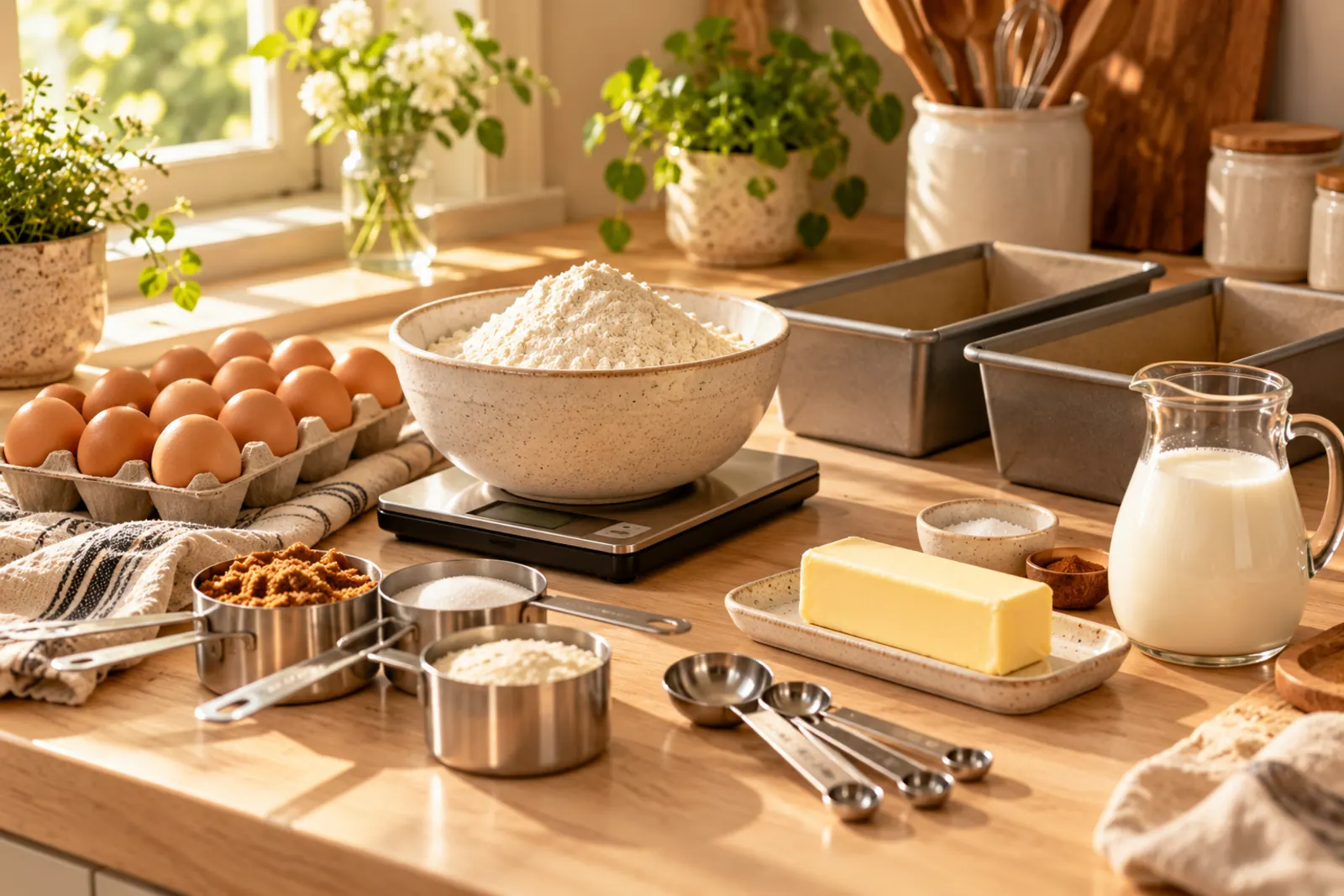
Finding a perfect recipe online only to realize it serves 4 people when you need 8? Or discovering a complicated dish that you'd love to make in smaller quantities? Recipe scaling is a fundamental cooking skill that saves time and reduces food waste. However, it's more nuanced than simply doubling or halving ingredient amounts.
Whether you're cooking for a dinner party or reducing portions for a small household, understanding how to properly scale recipes is essential. This comprehensive guide walks you through the math, common pitfalls, and how to use a recipe converter tool to make the process effortless.
The Basic Math Behind Recipe Scaling
The fundamental concept of scaling a recipe is straightforward: determine the scaling factor, then multiply each ingredient by that factor. Here's the formula:
Scaling Factor = Desired Servings ÷ Original Servings
For example, if you have a recipe that serves 4 people but you need to feed 8, your scaling factor is 2 (8 ÷ 4 = 2). You would double all your ingredients.
Conversely, if you want to make a recipe that serves 8 for just 2 people, your scaling factor is 0.25 (2 ÷ 8 = 0.25), meaning you use one-quarter of each ingredient.
Let's look at a practical example. Consider a simple pasta recipe:
- 2 cups pasta
- 4 cups water
- 2 tablespoons salt
- 1 jar (24 oz) tomato sauce
If you want to scale this to serve 8 people instead of 4, multiply each ingredient by 2:
- 4 cups pasta
- 8 cups water
- 4 tablespoons salt
- 2 jars (48 oz) tomato sauce
The math is simple, but as you'll see, there are important exceptions.
Why Baking Doesn't Scale Linearly
Here's where recipe scaling gets complicated: baking is fundamentally different from savory cooking. Baking is a science based on precise ratios and chemical reactions. Unlike a pasta sauce where you can generally double all ingredients without consequence, baking recipes require a more thoughtful approach.
The Problem with Scaling Baked Goods
When you scale a cake, bread, or cookie recipe, not all ingredients should scale equally. Consider these challenges:
- Leavening agents: Baking soda and baking powder don't scale linearly. Too much can create a soapy taste or cause cakes to collapse. Generally, leavening agents scale at 0.75 to 0.9 times the scaling factor
- Vanilla and extracts: These potent flavoring agents often scale at 0.75 to 0.9 times the factor. A vanilla cake scaled for 16 servings doesn't need 4 times the vanilla
- Spices: Most baking spices scale at 0.75 to 0.9 times the factor due to their intensity
- Salt: Salt can be scaled at 0.75 to 0.9 times for baked goods
- Liquid and flour: These usually scale proportionally, but very large bakes may need slight adjustments
For example, a brownie recipe serving 8 might call for 1 teaspoon of vanilla. If you want to scale it to serve 16, you wouldn't use 2 teaspoons. Instead, use about 1.5 teaspoons (0.75 × 2 = 1.5). You'll maintain better flavor balance.
Ingredient Categories That Don't Scale Proportionally
Beyond baking, several ingredient categories require special attention when scaling:
Seasonings and Aromatics
Salt, pepper, garlic, and onion are potent. When scaling a savory dish, you typically want less than a proportional amount. Many chefs recommend using 0.75 to 0.9 times the scaling factor for seasonings. Taste as you go and adjust—you can always add more salt, but you can't remove it.
Acidic Ingredients
Lemon juice, vinegar, and other acidic ingredients often scale at 0.75 times the factor. These ingredients are flavorful and adding too much can overpower a dish. Add half of what the scaled amount suggests, taste, and adjust.
Hot Peppers and Spices
Chili peppers, cayenne, and other heat-bearing ingredients should definitely be under-scaled. Use about 0.5 to 0.75 times the scaling factor. Heat intensity increases disproportionately, and your guests may appreciate restraint.
Herbs
Fresh herbs like basil and cilantro typically scale proportionally, but dried herbs are more concentrated and should use 0.5 to 0.75 times the scaling factor.
Common Recipe Scaling Mistakes
Mistake 1: Scaling Up a Recipe Without Testing
The biggest error home cooks make is assuming a scaled recipe will work perfectly. When you dramatically increase a recipe's size, ovens may not heat evenly, cooking times change, and ingredients may interact differently. Always test scaled recipes in smaller batches first, or reduce the scaling increment.
Mistake 2: Doubling Everything in a Baked Good
As discussed, leavening agents, extracts, and spices don't double well in baked goods. Doubling a cake recipe's leavening will result in a cake that rises too quickly, then collapses.
Mistake 3: Scaling Dishes with Whole Ingredients
Recipes calling for "1 large potato" or "2 eggs" don't scale cleanly. When scaling by a factor of 1.5, do you use 3 eggs? Or more? Judge by weight and volume instead. One large potato might equal 300 grams; scale to 450 grams for a 1.5x recipe.
Mistake 4: Ignoring Cooking Time and Temperature
Larger batches often require longer cooking times, but not always in proportion to the recipe size. A baked good taking 25 minutes for 8 servings might take 30-35 minutes (not 50 minutes) for 16 servings. Oven capacity and heat distribution matter enormously.
Mistake 5: Forgetting to Adjust Equipment
Scaling a recipe means nothing if your pot, pan, or baking dish is too small. When scaling up significantly, ensure you have appropriately sized equipment. Overcrowded pans affect cooking times and results.
Practical Tips for Successfully Scaling Recipes
Tip 1: Use Weight Measurements
Grams and ounces are far more precise than cups and tablespoons. When possible, convert volume measurements to weight. This makes scaling exponentially easier and more accurate. Most recipe conversion tools include weight measurements for this reason.
Tip 2: Scale to Common Serving Sizes
Instead of scaling to an awkward number like 7 servings, scale to round numbers: 4, 6, 8, 12, 16. This reduces math errors and makes ingredient adjustments more intuitive.
Tip 3: Taste and Adjust
For savory dishes, add 75% of scaled seasonings initially, then taste and adjust. This safety-first approach prevents over-seasoning.
Tip 4: Write Down Your Adjustments
When you scale a recipe successfully, note what you changed. Did you use 0.75x the spices? Did you add the salt in stages? These notes make future scaling attempts easier.
Tip 5: Consider the Cooking Method
Grilling, simmering, baking, and frying all respond differently to scaling. A stew scales easily because long, moist cooking time neutralizes minor variations. A delicate soufflé does not.
Use a Free Recipe Converter Tool
While understanding the math is valuable, the best approach is using a recipe converter tool that handles the calculations for you. Our free recipe converter tool does the heavy lifting instantly.
Here's how it works: Input your original recipe servings, desired servings, and your ingredients. The tool calculates the proper scaling factor and applies recommended multipliers for different ingredient types. No more mental math while cooking.
For recipes with ingredients that don't scale linearly—especially baked goods—the converter helps you avoid the common mistakes discussed above. It's particularly useful when you're working with unfamiliar recipes or trying complex bakes.
Real-World Scaling Examples
Example 1: Scaling a Pasta Sauce (Doubles Well)
Original recipe serves 4:
- 2 tablespoons olive oil
- 4 cloves garlic, minced
- 1 can (28 oz) crushed tomatoes
- 1 tablespoon salt
- 1 teaspoon black pepper
To scale for 8 servings (2x factor), you could simply double everything. However, apply the seasoning rule and use 0.75x for salt and pepper:
- 4 tablespoons olive oil
- 8 cloves garlic, minced
- 2 cans (56 oz) crushed tomatoes
- 1.5 tablespoons salt (0.75 × 2)
- 1.5 teaspoons black pepper (0.75 × 2)
Example 2: Scaling a Chocolate Cake (Requires Adjustments)
Original recipe serves 8:
- 2 cups flour
- 1.5 cups sugar
- 3/4 cup cocoa powder
- 2 teaspoons baking soda
- 1 teaspoon salt
- 2 eggs
- 1 teaspoon vanilla extract
- 1 cup buttermilk
To scale for 16 servings (2x factor), adjust leavening and flavor agents:
- 4 cups flour (multiply by 2)
- 3 cups sugar (multiply by 2)
- 1.5 cups cocoa powder (multiply by 2)
- 3.5 teaspoons baking soda (1.75 × 2, using 0.875 multiplier)
- 1.5 teaspoons salt (0.75 × 2)
- 4 eggs (multiply by 2)
- 1.75 teaspoons vanilla extract (0.875 × 2)
- 2 cups buttermilk (multiply by 2)
Notice how baking soda, salt, and vanilla weren't simply doubled—that would result in an overly leavened, salty, and vanilla-heavy cake.
When Recipe Scaling Gets Really Complex
Some recipes resist scaling. Techniques like bread doughs with long fermentation times, delicate pastries requiring precise chemistry, and dishes dependent on specific pan heat distribution become unpredictable at large scales. In these cases, consider:
- Making multiple batches of the original-sized recipe rather than scaling up dramatically
- Finding a recipe already written for your desired serving size
- Consulting professional recipe-scaling resources or cookbooks
Start Scaling with Confidence
Recipe scaling is both art and science. Understanding the basics—the scaling factor, ingredient categories that don't scale linearly, and common mistakes—gives you the confidence to adapt recipes for any occasion. Pair this knowledge with our free recipe converter tool and you'll never be caught off-guard by serving size mismatches again.
Ready to start building your perfect recipe collection? Save your favorite recipes with RecipeVault and use our converter tool to scale them perfectly every time.
Want the numbers for your own recipe? Paste it into our free recipe calorie calculator to get calories and protein per serving, plus the swaps that cut the most.
Save & Organize Your Recipes with RecipeVault
Import recipes from any website, YouTube, TikTok, or Instagram. Scale servings, plan meals, and build your digital cookbook.